I called up a store today complaining that I hadn't received a package. They found my order, confirmed it had been sent... and then said offhand "it'll fit through the letterbox and it's not signed-for".
As I'm walking out of the building, I realise that I haven't checked - and lo and behold, the package was in my mailbox at work. Ha, that'll teach me to check it occasionally.
Should also actually get the new HD droplinks for the car tomorrow, too, so the shoot is on for the 13th.
03/11/2011

02/11/2011
bit of a bargain today
actually, three.
One is a PCI gigabit network card. That's great as it means I can use a virtually silent machine as gateway.
Second is two softboxes; one 30x120 and the other 80x100 or so (don't really care, it's not quite square) from falcon eyes. If you've tried to make softboxes, you'll know how difficult it is, and these are also collapsible. Lovely stuff. Striplight, too. Now all I need is a clean car or two to photograph for the calender!
One is a PCI gigabit network card. That's great as it means I can use a virtually silent machine as gateway.
Second is two softboxes; one 30x120 and the other 80x100 or so (don't really care, it's not quite square) from falcon eyes. If you've tried to make softboxes, you'll know how difficult it is, and these are also collapsible. Lovely stuff. Striplight, too. Now all I need is a clean car or two to photograph for the calender!
hyperfocal distance - another effect of crop factor
Hyperfocal distances are interesting. No, really. I'll explain: The eye is relatively easy to confuse. I'll explain that later on.
There's something called the "circle of confusion" (coc) and this is essentially the smallest thing the eye can detect as being "sharp", i.e. not blurred. This is in reality generally around 0.2mm, but changes in Digital circles with the size of the sensor. Bottom line? For an APS-C camera (so a D7000, K5 and the like, but not µ4/3 or full frame) it's considered to be 0.02mm. More here but to be honest, we just need the 0.02. This is another reason why it's nice to know the size of your sensor
Hyperfocal distances use this coc to their advantage. If you focus a lens at a specific distance then everything between half that point and infinity will be in focus. The distance varies for the focal length of the lens used - so a 28mm has a greater hyperfocal distance than a 10mm - and the aperture used. That should start to explain why wide lenses have such a greater depth of field than a long telephoto.
There's a rather good wikipedia article on the subject of hyperfocal distances, and it includes the following formula:
focal squared / f x 0.02
that's it. It's not complex.
Example: 28mm lens, f8.
28 x 28 = 784
8 x 0.02 = 0.16
784 / 0.16 = 4900
Therefore: set focus to 5m and f8 on that 28mm SMC-M and leave it; everything between 2.5m and infinity will be in focus.
I've been testing this at work for video footage and it functions pretty well. Everything really is reasonably in focus, too, and that to infinity.
To make it really easy and to give some reference points, here a quick table, working in mm at both f8 and f16. You can do the rest of the maths yourselves.
Set focus to these distances and everything from within half of the distance to infinity will be acceptably in focus.
mm....f...distance
10....8....625
12....8....900
14....8....1225
15....8....1406.25
16....8....1600
18....8....2025
20....8....2500
24....8....3600
28....8....4900
30....8....5625
40....8....10000
10....16....312.5
12....16....450
14....16....612.5
15....16....703.13
16....16....800
18....16....1012.5
20....16....1250
24....16....1800
28....16....2450
30....16....2812.5
40....16....5000
- Bret
There's something called the "circle of confusion" (coc) and this is essentially the smallest thing the eye can detect as being "sharp", i.e. not blurred. This is in reality generally around 0.2mm, but changes in Digital circles with the size of the sensor. Bottom line? For an APS-C camera (so a D7000, K5 and the like, but not µ4/3 or full frame) it's considered to be 0.02mm. More here but to be honest, we just need the 0.02. This is another reason why it's nice to know the size of your sensor
Hyperfocal distances use this coc to their advantage. If you focus a lens at a specific distance then everything between half that point and infinity will be in focus. The distance varies for the focal length of the lens used - so a 28mm has a greater hyperfocal distance than a 10mm - and the aperture used. That should start to explain why wide lenses have such a greater depth of field than a long telephoto.
There's a rather good wikipedia article on the subject of hyperfocal distances, and it includes the following formula:
focal squared / f x 0.02
that's it. It's not complex.
Example: 28mm lens, f8.
28 x 28 = 784
8 x 0.02 = 0.16
784 / 0.16 = 4900
Therefore: set focus to 5m and f8 on that 28mm SMC-M and leave it; everything between 2.5m and infinity will be in focus.
I've been testing this at work for video footage and it functions pretty well. Everything really is reasonably in focus, too, and that to infinity.
To make it really easy and to give some reference points, here a quick table, working in mm at both f8 and f16. You can do the rest of the maths yourselves.
Set focus to these distances and everything from within half of the distance to infinity will be acceptably in focus.
mm....f...distance
10....8....625
12....8....900
14....8....1225
15....8....1406.25
16....8....1600
18....8....2025
20....8....2500
24....8....3600
28....8....4900
30....8....5625
40....8....10000
10....16....312.5
12....16....450
14....16....612.5
15....16....703.13
16....16....800
18....16....1012.5
20....16....1250
24....16....1800
28....16....2450
30....16....2812.5
40....16....5000
- Bret
01/11/2011
couple of shots from this evening
the conservatory has 10 floors. From the 9th, you get a rather good view (especially at this time of year, because it's dark early so there's still lots of traffic).
On the other hand, I still had the 100-300 on the front... and that was a bit too long. But I had no filters with me, which I would normally use for this kind of thing. Around 35mm and 1.5 - 3 minutes would be excellent, but that's not going to happen any time soon. Anyway, there's light on the inside of the building, so I'd get a reflection of myself in the pic.
These are f22, 25s, ISO80 exposures.
I quite like the way these have come out. (Click to embiggen!)
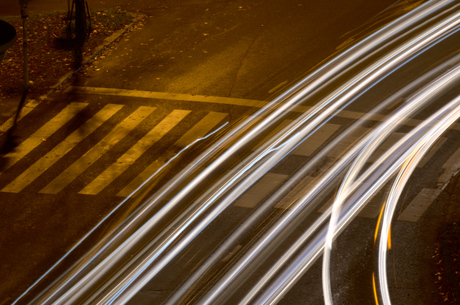

I really like the "left turn requires brakes!" and then the clean turn with the front lights.
- Bret
On the other hand, I still had the 100-300 on the front... and that was a bit too long. But I had no filters with me, which I would normally use for this kind of thing. Around 35mm and 1.5 - 3 minutes would be excellent, but that's not going to happen any time soon. Anyway, there's light on the inside of the building, so I'd get a reflection of myself in the pic.
These are f22, 25s, ISO80 exposures.
I quite like the way these have come out. (Click to embiggen!)
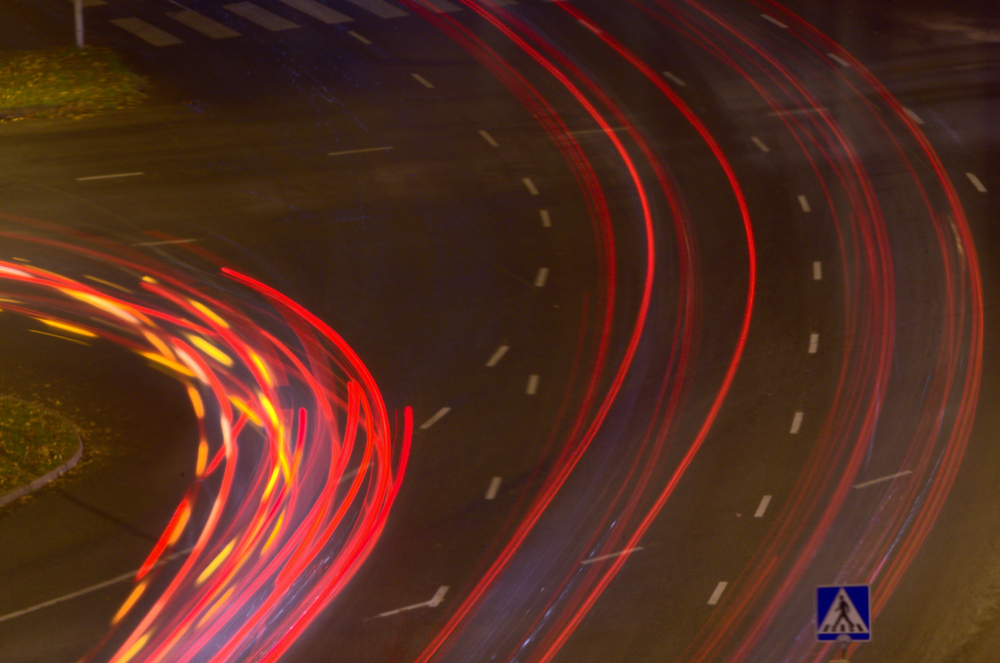
I really like the "left turn requires brakes!" and then the clean turn with the front lights.
- Bret
crop factor: using it
I wrote recently about crop factor. Well, here's an example of why you might want to be able to understand it....
There's a pic posted and it's from a Canon A720IS. That doesn't save any 35mm-equiv information in the EXIFs (that's the information saved with the file, which includes camera model, shutter speed, aperture etc.). It only saves the "real" number.
Now, I wrote that the real use of crop factors is in converting between systems. In this case, it's most definitely true as someone wanted to know what lens the "5.8mm" was with. The shortest lenses I know of are around the 8mm mark and they are fisheyes - the pic was too "real" to be really 5mm in 35mm world.
This - http://en.wikipedia.org/wiki/Image_sensor_format - tells us the crop format for the 1 2/5" sensor used is around 6, so 6 x 6 = 35mm or so.
So, I think you'll find that the field of view represented by the pic is pretty close to a 35mm on FF or 20mm on APS-C.
Couple of tips:
- at least Windows 7 has the option to show this information in fields in Explorer (try "35mm focal length")
- PhotoME is a great application to read this information from pics, including in my case the camera temperature and shutter actuations.
- Bret
There's a pic posted and it's from a Canon A720IS. That doesn't save any 35mm-equiv information in the EXIFs (that's the information saved with the file, which includes camera model, shutter speed, aperture etc.). It only saves the "real" number.
Now, I wrote that the real use of crop factors is in converting between systems. In this case, it's most definitely true as someone wanted to know what lens the "5.8mm" was with. The shortest lenses I know of are around the 8mm mark and they are fisheyes - the pic was too "real" to be really 5mm in 35mm world.
This - http://en.wikipedia.org/wiki/Image_sensor_format - tells us the crop format for the 1 2/5" sensor used is around 6, so 6 x 6 = 35mm or so.
So, I think you'll find that the field of view represented by the pic is pretty close to a 35mm on FF or 20mm on APS-C.
Couple of tips:
- at least Windows 7 has the option to show this information in fields in Explorer (try "35mm focal length")
- PhotoME is a great application to read this information from pics, including in my case the camera temperature and shutter actuations.
- Bret
audio - quick link
now I'm involved in a lot of audio stuff at work, too, so this is a quickie: http://www.mcsquared.com/wavelength.htm
We've got a conf room that echoes. Two minutes with the Focal test disc #2 tell us approximately where the resonances are - around 500Hz - and therefore how we can begin to deal with them. In this case that probably means thick curtains, spaced at 6" or so apart / 17cm. Let's see if it works...
- Bret
We've got a conf room that echoes. Two minutes with the Focal test disc #2 tell us approximately where the resonances are - around 500Hz - and therefore how we can begin to deal with them. In this case that probably means thick curtains, spaced at 6" or so apart / 17cm. Let's see if it works...
- Bret
droid and google
I've been using a 'droid phone (htc wildfire) for work and to be honest, I'm nonplussed.
I use an N900 on a daily basis and there are still two S60 and one S40 Nokias in the house. I've used S90, S80 and S60 over a period of years.
Things that *really* bug me about the htc:
- I expect a phone to act as one when it's connected to a PC, not just mass storage. DUN as a minimum.
- Keyboards that are that hard to use for people with "sausage fingers" are not funny. My little monster found it great - I hated it. As did the other half.
- When the keyboard covers half of the field you're supposed to be entering, that's plain silly.
- the battery life is a joke (2 days max, without using it)
- why can't I take screenshots?
- why can't I close an application?
- Why on earth do I NEED a google account to install even an app? I can't even download one from the googlemarket without a google account - and this one won't work, because there's no SIM in the phone, so therefore I can't have the account confirmed.
If you think that last point through, that's pretty damned close to the glass citizen. Google would then know:
- what phone I have
- what apps are theoretically on it
- where I am
- my opinions via blog and / or plus
- my acquaintances across the planet via plus
- which blogs I read
add into that a significant proportion of my search history and away we go....
My next phone will not be droid. Probably an N9 or a Lumia.
- Bret
I use an N900 on a daily basis and there are still two S60 and one S40 Nokias in the house. I've used S90, S80 and S60 over a period of years.
Things that *really* bug me about the htc:
- I expect a phone to act as one when it's connected to a PC, not just mass storage. DUN as a minimum.
- Keyboards that are that hard to use for people with "sausage fingers" are not funny. My little monster found it great - I hated it. As did the other half.
- When the keyboard covers half of the field you're supposed to be entering, that's plain silly.
- the battery life is a joke (2 days max, without using it)
- why can't I take screenshots?
- why can't I close an application?
- Why on earth do I NEED a google account to install even an app? I can't even download one from the googlemarket without a google account - and this one won't work, because there's no SIM in the phone, so therefore I can't have the account confirmed.
If you think that last point through, that's pretty damned close to the glass citizen. Google would then know:
- what phone I have
- what apps are theoretically on it
- where I am
- my opinions via blog and / or plus
- my acquaintances across the planet via plus
- which blogs I read
add into that a significant proportion of my search history and away we go....
My next phone will not be droid. Probably an N9 or a Lumia.
- Bret
Subscribe to:
Posts (Atom)